Buying a CNC woodworking machine is one of the biggest investments a furniture manufacturer makes. Pick the right one and you cut panels faster, waste less board and deliver modular kitchens and wardrobes on time. Pick the wrong one and you pay for features you never use, or worse, a machine that becomes the bottleneck of your factory.
India's furniture industry is shifting fast from manual cutting to CNC. Customers want precise modular kitchens, wardrobes and office furniture, delivered quickly. Whether you run a 5-person workshop in a city like Bengaluru, Kochi, Delhi or Ahmedabad, or a full production plant, the right CNC woodworking machine decides how much you can grow.
In simple steps, how to choose a CNC machine that fits your products, your panel sizes, your budget and your future plans.
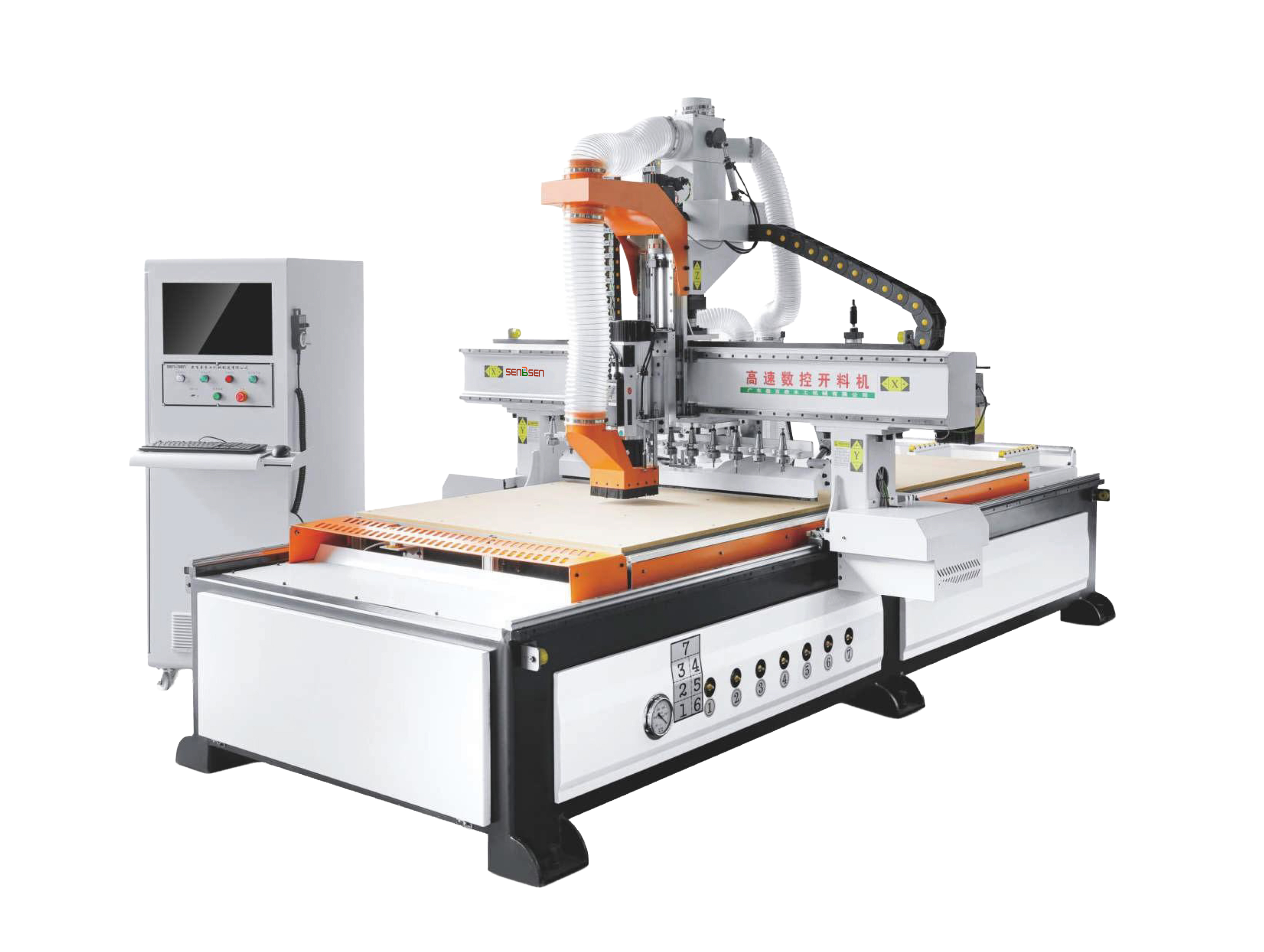
Quick answer: Choose a CNC woodworking machine by matching it to (1) the products you make, (2) your daily panel volume, (3) your standard board size, (4) the operations you need (cutting, routing, drilling, grooving), and (5) the after-sales support available near your factory. For most modular furniture makers in India, a CNC nesting router handling full 8x4 ft sheets is the best starting point, supported by a panel saw and an edge bander.
Types of CNC Woodworking Machines at a Glance
Each type of CNC woodworking machine does a different job. Use this overview to shortlist the right type before you compare models.
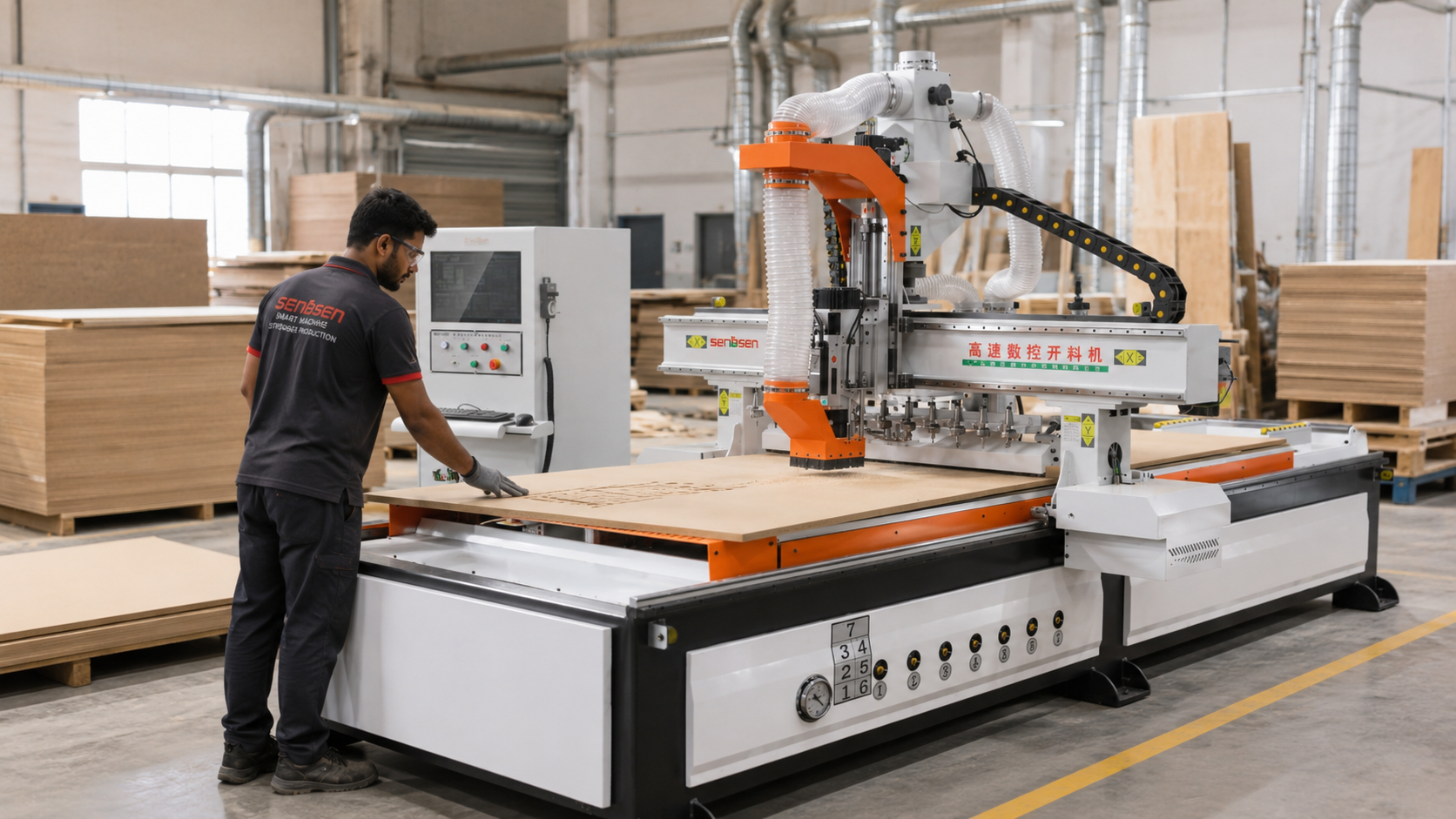
1. CNC Nesting Router Cuts full sheets, routes, grooves and drills vertical holes in one cycle. It is best for modular kitchens, wardrobes and cabinets made from plywood, MDF or particle board, and suits growing modular furniture makers.
2. Standard CNC Router Handles routing, profiling, engraving and 2D/3D carving. It is ideal for doors, decorative panels, jaalis and custom designs, making it a strong fit for interior and custom furniture workshops.
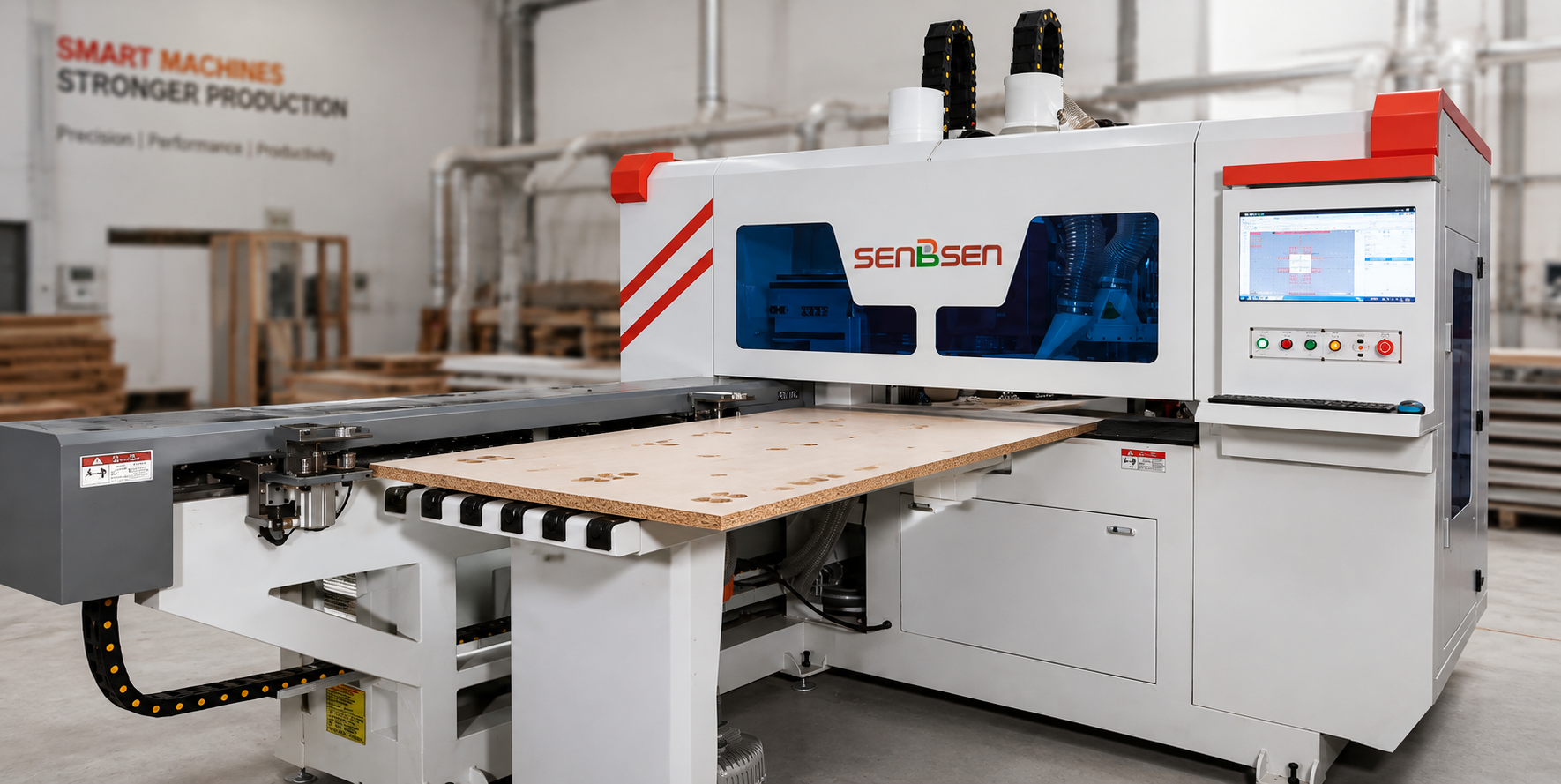
3. CNC Drilling Machine (6-Sided) Drills precise hinge, dowel, shelf-pin and fitting holes on every face of a panel without manual flipping. It suits mid-to-large factories doing high-volume cabinet and wardrobe assembly.
4. CNC Panel Saw / Beam Saw Delivers fast, straight and accurate rip and cross cuts, often on stacked boards. It is the choice for factories with high-volume panel sizing.
5. Edge Banding Machine (Supporting Machine) Seals, trims, scrapes and buffs panel edges after cutting. Every panel furniture unit needs one to give cut parts a clean, durable finish.
Most furniture factories need a combination. A typical modular furniture line runs: panel saw or nesting CNC → edge bander → CNC drilling → assembly.
10 Factors to Consider When Choosing a CNC Woodworking Machine
1. Define Your Furniture Products and Production Volume
Start with what you make, not with the machine brochure. A modular kitchen maker needs fast sheet cutting and drilling. A custom interior workshop needs routing flexibility for unique designs.
Answer these before talking to any supplier:
What do you mainly make: modular kitchens, wardrobes, office furniture, cabinets or custom interiors?
Which materials do you use most: plywood, MDF, particle board, pre-laminated board or solid wood?
How many sheets do you process per day today, and how many in 2–3 years?
Which operations do you need: cutting, routing, drilling, grooving, or all of them?
How many shifts do you run?
Your answers decide the machine type, size and automation level you need.
2. Choose the Right Type of CNC Woodworking Machine
Matching the machine type to your work avoids paying for features you won't use.
CNC router machine for wood: ideal for routing, profiling, grooving and engraving. Good for doors, decorative panels and custom designs.
CNC nesting machine for modular furniture: cuts all parts of a cabinet from a full sheet in one cycle, with grooves and vertical holes. Nesting software arranges parts to reduce board waste, which directly saves money on every sheet.
CNC drilling machine for furniture: gives accurate, repeatable holes for hinges, dowels, shelf pins and fittings. Six-sided drilling machines handle all faces of a panel without manual flipping.
CNC panel processing line: for high volume, combine a panel saw machine, an edge banding machine and CNC drilling into one workflow.
3. Check the Working Area and Panel Size
In India, the standard board size is 8x4 ft (2440 x 1220 mm). Your CNC table must handle full sheets comfortably, or you lose time pre-cutting.
Before buying, verify:
Maximum working length and width (look for at least 2500 x 1250 mm for full sheets)
Maximum material thickness and Z-axis clearance
Vacuum table strength for holding small parts
Loading and unloading method (manual, or automatic with loading table)
Floor space needed for the machine, material movement and dust collection
4. Evaluate Accuracy and Cutting Quality
A 0.5 mm error on one panel becomes a misaligned shutter on site. Accuracy is non-negotiable in modular furniture.
Compare positioning accuracy, repeatability and frame rigidity on the spec sheet. Then ask for a live demo on your own material and your own design. Inspect edge finish, chipping on laminated boards, hole position and groove depth.
Remember that final quality also depends on tooling, calibration, programming and operator skill.
5. Compare Spindle Power and Machine Construction
The spindle is the heart of a CNC router. Check its power (kW), speed range (RPM), cooling type (air or water) and tool holder type.
An ATC (automatic tool changer) spindle switches tools automatically between cutting, grooving and drilling. It saves significant time compared with manual tool changes in multi-operation jobs.
Equally important: a heavy, welded steel frame, quality guide rails, rack and pinion or ball screws, and reliable servo motors. These decide how stable the machine stays after years of daily use.
6. Check Software and Ease of Operation
A CNC machine is only as productive as the team operating it. Check:
Compatibility with your design and CAD/CAM software
Built-in nesting and cabinet design software
How easily designs import and toolpaths generate
Whether the control panel is simple for your operators to learn
Operator training, troubleshooting support and software updates
7. Calculate the Total Cost of Ownership
The price tag is only the start. Budget for:
Installation and foundation work
Operator training
Tooling and cutters
Electricity and a stable power supply (stabilizer or UPS)
Dust collector and compressor
Annual maintenance and spare parts
Downtime cost if the machine stops
Then estimate returns: labour saved, fewer re-cuts, less board waste and higher daily output. A cheap machine with poor support often costs more within two years.
8. Confirm Installation, Training and After-Sales Support
This is the factor most buyers underestimate. When a CNC stops, your whole production stops.
Ask every supplier:
Who installs and commissions the machine?
How many days of operator training are included?
How fast does a service engineer reach your factory?
Are spare parts stocked in India?
Is remote troubleshooting available?
What does the warranty cover, and for how long?
9. Plan for Future Growth
Buy for where your business will be in three years, not only today. Consider whether you will add shifts, new product lines or automatic loading and unloading. A machine that can be upgraded, or that fits into a larger production line, protects your investment.
10. Choose a Reliable Supplier, Not Just a Machine
The right partner helps you plan your factory layout, choose the right configuration and keep machines running. Visit an existing customer installation, talk to their operators and check how the supplier handled service calls.
CNC Woodworking Machine Buying Checklist
Save or print this checklist before your next supplier meeting.
Products, materials and daily sheet volume defined
Machine type shortlisted (router, nesting, drilling, panel saw)
Working area handles full 8x4 ft sheets
Spindle power, ATC and tool count confirmed
Live demo seen on your own material and design
Software compatible with your design workflow
Total cost of ownership calculated, not just price
Installation, training and warranty terms in writing
Service response time and spare parts availability confirmed
Existing customer installation visited
5 Common Mistakes to Avoid When Buying a CNC Woodworking Machine
Buying on price alone. The cheapest quote often hides weak support, low-grade components or missing accessories.
Ignoring after-sales service. A machine without nearby engineers and spare parts can sit idle for weeks.
Choosing a table smaller than your sheets. Pre-cutting boards defeats the purpose of CNC.
Skipping operator training. An untrained operator wastes material and damages tools.
Not planning the full line. A fast CNC with slow edge banding just moves the bottleneck.
Why Choose SENBSEN for CNC Woodworking Machines in India?
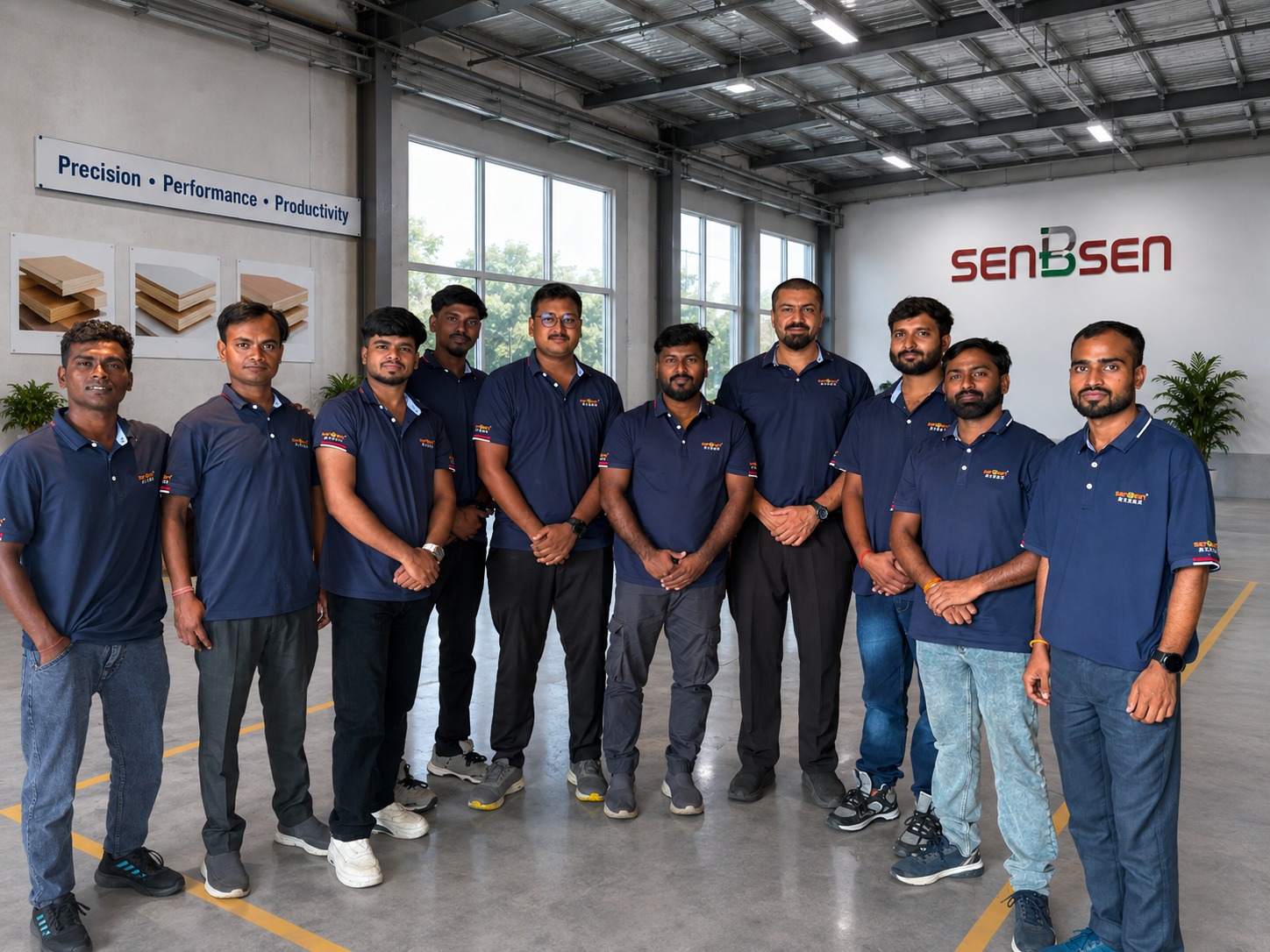
SENBSEN India, based in Bengaluru, supplies woodworking machinery to furniture manufacturers across India, with presence in Karnataka, Kerala, Delhi and Gujarat.
What SENBSEN offers furniture makers:
Complete range for panel furniture: CNC routers, panel saws, edge banders, cold presses and intelligent production lines, so one partner can plan your whole workflow.
Configuration guidance: the team studies your products, board sizes and daily output to recommend the right model, not the most expensive one.
Installation and training: support with commissioning the machine and training your operators.
Field service engineers: a technical team to support you after installation.
Factory layout planning: help designing a production line that avoids bottlenecks.
Planning to buy a CNC machine? Share your product range, sheet volume and factory size with the SENBSEN team for a free consultation and a quotation based on your actual requirements. Call +91 87080 56233 or email info@senbsen.in.
Frequently Asked Questions
1. Which CNC woodworking machine is best for furniture manufacturing?
It depends on your products. A CNC nesting router is best for modular kitchens and wardrobes made from sheet boards. A standard CNC router suits custom and decorative work. A CNC drilling machine is best for high-volume hinge and fitting holes.
2. What is the difference between a CNC router and a CNC nesting machine?
A CNC router performs routing, profiling and engraving on individual parts. A nesting machine is a CNC router optimised to cut all parts of a job from full sheets in one cycle, using software that arranges parts to minimise waste.
3. Is a CNC machine suitable for modular kitchen manufacturing?
Yes. A CNC nesting machine handles cutting, grooving and drilling for kitchen carcasses and shutters. Pair it with an edge banding machine for a complete modular kitchen workflow.
4. What is the price of a CNC woodworking machine in India?
Prices vary widely by machine type, table size, spindle, automatic tool changer, software and automation. Request a quotation based on your actual production needs and compare total cost of ownership, not just the purchase price.
5. What materials can a CNC woodworking machine cut?
Depending on tooling and configuration, it can process plywood, MDF, particle board, pre-laminated boards, HDHMR, solid wood and acrylic. Always confirm compatibility with the supplier.
6. Can a small workshop afford a CNC woodworking machine?
Yes. Many small workshops start with a single CNC router or nesting machine and add equipment as orders grow. The labour savings and reduced material waste help recover the investment.
7. Can a CNC machine reduce material waste?
Yes. Nesting software arranges parts tightly on each sheet, and accurate cutting reduces re-cuts. Actual savings depend on design, nesting settings, tooling and operator practice.
8. What size CNC machine do I need for 8x4 plywood sheets?
Choose a working area of at least 2500 x 1250 mm so full 2440 x 1220 mm sheets load without pre-cutting.
9. What should I check before buying a CNC machine?
Check working area, accuracy, spindle and tool changer, software, power requirements, warranty, training, spare parts availability and service response time. A live demo on your own material is the best test.
10. Does SENBSEN provide installation and training?
Contact SENBSEN India to confirm installation, operator training and after-sales services for your selected machine and location.
Conclusion
Choosing the right CNC woodworking machine comes down to matching the machine to your products, panel sizes, daily volume and growth plans, and then backing it with reliable support. Don't buy on price alone. Compare specifications, see a live demo on your own material and confirm service before you sign.
The right CNC woodworking machine improves accuracy, cuts waste and lets your factory take on bigger orders with confidence.
Ready to upgrade your furniture production? Talk to the SENBSEN team today for expert guidance on the right CNC woodworking machine for your workshop.
Contact SENBSEN India
SENBSEN India – Woodworking Machinery | Bengaluru, India
Address: Site No. 51, New Katha No. 89, Vaddarahalli Village, Bengaluru, Karnataka 562130
Phone / WhatsApp: +91 87080 56233
Email: info@senbsen.in
Instagram: @senbsenindia
Website: senbsen.in
SENBSEN – Precision • Performance • Productivity