The best drilling machine for modular kitchens is one that puts every hole in exactly the right place, at the right depth, every single time. In a modular kitchen, almost everything depends on holes: hinges, handles, shelf supports, dowels, cam locks and drawer runners all sit on drilled positions.
A cabinet is not built from one piece of wood. It is assembled from many panels, and those panels only fit together if their holes line up. When a hinge hole is off by a millimetre or two, the shutter sags. When shelf-support holes drift, the shelf rocks. When connector holes don't match, the carcass won't close square.
Manual drilling with a hand drill or a simple bench drill can work for one-off jobs. But it depends on the operator's eye and patience, it is slow, and it becomes inconsistent as volume grows. That is why serious modular kitchen manufacturers are moving to automatic and CNC drilling. This guide explains the machine types, the features that matter, and how to choose the right one for your factory.
What Is a Drilling Machine for Modular Kitchens?
A drilling machine for modular kitchens is a woodworking machine that bores precise holes into furniture panels such as particle board, MDF, HDHMR and plywood. These holes are used for hardware fitting and for joining panels together.
In modular furniture production, drilling sits between cutting and assembly. Panels are cut to size, edges are banded, and then each panel is drilled according to its role in the cabinet: side panel, base, top, back, shelf or shutter.
Two kinds of drilling matter most:
Panel drilling covers face and edge holes for dowels, cam locks, connectors and shelf supports, usually on the 32 mm system grid.
Hinge-hole drilling creates the larger concealed-hinge cups (commonly 35 mm diameter) on cabinet shutters, along with the small screw holes around them.
Which Drilling Machine Is Best for Modular Kitchens?
There is no single "best" machine for every workshop. But for modular kitchen production, the best drilling machine consistently delivers the following:
CNC-controlled drilling. Hole positions come from a program, not from marking and measuring by hand. Load the design, and the machine drills the same pattern every time.
Multiple drilling heads or spindles. Several bits work together, so a row of shelf holes or a connector pattern is drilled in one cycle instead of hole by hole.
Accurate hole positioning. Hinges, connectors and shelf supports need tight tolerances. Good machines hold position reliably across the full panel length.
Adjustable drilling depth. Depth control prevents blow-through on thin panels and ensures hinge cups and dowel holes are deep enough.
High production speed. Fast travel and multi-spindle drilling cut cycle time per panel, which matters when you are making dozens of cabinets a week.
Easy-to-use control system. Operators should be able to load programs, set panels and run jobs without deep programming knowledge.
Consistent results. The thousandth panel should match the first. Consistency is what makes cabinets assemble cleanly on site.
Low material wastage. Fewer drilling errors means fewer rejected panels, which directly protects your margins on costly boards and laminates.
In short, for medium to high-volume modular kitchen manufacturing, a CNC drilling machine with multiple spindles and a simple control system is generally the best choice.
Types of Drilling Machines for Modular Kitchen Manufacturing
Drilling machines range from simple hand-guided tools to fully programmed CNC systems. Each suits a different scale of work.
Manual Drilling Machine
The operator marks, positions and drills each hole by hand or with a bench drill. It suits small workshops, repairs and one-off pieces, but it is slow, depends heavily on the operator and becomes inconsistent at higher volumes.
Semi-Automatic Drilling Machine
Fixed multi-spindle heads drill while the operator positions the panel against stops. It works well for small to medium batches with standard patterns, though changing patterns needs manual setup and flexibility is limited.
Automatic Drilling Machine
The machine handles positioning and drilling cycles with minimal operator input. It is a good fit for medium-volume production with repeat designs, but it is less flexible than CNC when designs change often.
CNC Drilling Machine
A computer program controls hole positions, depths and sequences. It is ideal for medium to high-volume, mixed-design production. The investment is higher and operators need basic training, but accuracy and flexibility are the best of all four types.
For medium to high-volume modular kitchen production, automatic and CNC drilling solutions are generally more suitable. They handle changing cabinet sizes and hole patterns quickly, and they remove most of the human error that manual drilling brings.
Important Features to Look For
Before you compare prices, compare these features. They decide how well the machine will perform on your shop floor for years.
Drilling accuracy. Ask for the machine's positioning accuracy and repeatability. Small errors multiply across a cabinet with dozens of holes.
Spindle configuration. Check how many vertical and horizontal spindles the machine has. More spindles mean more holes per cycle and fewer tool changes.
Hole pattern flexibility. Modular kitchens use many cabinet sizes. The machine should switch between hole patterns quickly, ideally by loading a new program.
Drilling depth control. Precise depth settings protect thin panels and ensure hinge cups and dowel holes are correct.
Workpiece positioning. Look at how panels are clamped and referenced. Reliable clamping and positioning prevent panels from shifting mid-cycle.
Machine stability. A heavy, rigid frame reduces vibration, which improves hole quality and tool life.
Production capacity. Match the machine's cycle time and panel-size range to your daily output and largest panels.
Software and control system. A clear interface and compatibility with your design software (for example, importing panel data) saves operator time and reduces errors.
Safety features. Emergency stops, guarding and safe clamping protect operators during high-speed work.
Maintenance requirements. Ask about lubrication schedules, spindle servicing and spare-parts availability in India. Easy maintenance means less downtime.
Why Accuracy Matters in Modular Kitchens
In a modular kitchen, a small drilling error rarely stays small. It shows up later as a misaligned shutter, a wobbly shelf or a carcass that won't sit square on site.
Cabinet hinges. Concealed hinges need the cup hole at the correct distance from the shutter edge. If it is off, shutters won't align and gaps look uneven.
Drawer components. Runner and slide holes must match on both sides of the cabinet, or drawers will bind, tilt or fail to close smoothly.
Shelf support holes. Rows of shelf-pin holes on the 32 mm grid must be level on both side panels. A slight drift makes shelves rock.
Dowels and connectors. Cam locks and dowels pull panels together. Misplaced holes leave gaps or force the installer to re-drill on site.
Handles. Handle holes on shutters and drawer fronts must be identical across a kitchen run. Customers notice when handles don't line up.
Panel-to-panel assembly. Every joint depends on matching holes. Accurate drilling means the kitchen assembles quickly at the customer's home without rework.
Precise drilling saves installation time, reduces complaints and protects your brand's reputation for quality.
Automatic vs Manual Drilling
Automatic and CNC drilling win on every factor that matters for production work.
Accuracy: Manual drilling is operator dependent, while automatic/CNC drilling is consistent.
Production speed: Manual drilling is lower; automatic/CNC drilling is higher.
Repeatability: Manual drilling is variable; automatic/CNC drilling is high.
Labour requirement: Manual drilling needs more labour; automatic/CNC drilling needs less.
Suitable for: Manual drilling suits small jobs; automatic/CNC drilling suits production work.
Manual drilling still has a place in small workshops and for site adjustments. But once you are producing kitchens every week, the time and rework costs of manual drilling quickly outweigh the savings.
How to Choose the Right Drilling Machine
Use this checklist before you buy. Answer each point honestly, and the right machine category becomes clear.
Daily production volume: How many panels or cabinets do you make per day now?
Panel sizes: What are your longest, widest and thickest panels?
Required hole patterns: Which hinge, connector, shelf and handle patterns do you use regularly?
Required accuracy: What tolerance do your hardware brands and installers need?
Available workshop space: Is there room for the machine plus panel loading and unloading?
Operator skill: Who will run the machine, and how much training will they need?
Budget: What is your investment range, and what payback period do you expect?
Future production requirements: Will your volume grow in the next two to three years?
After-sales service: Does the supplier offer installation, training, spare parts and quick service support near you?
If your volume is growing and you produce varied cabinet sizes, a CNC drilling machine is usually the safest long-term investment.
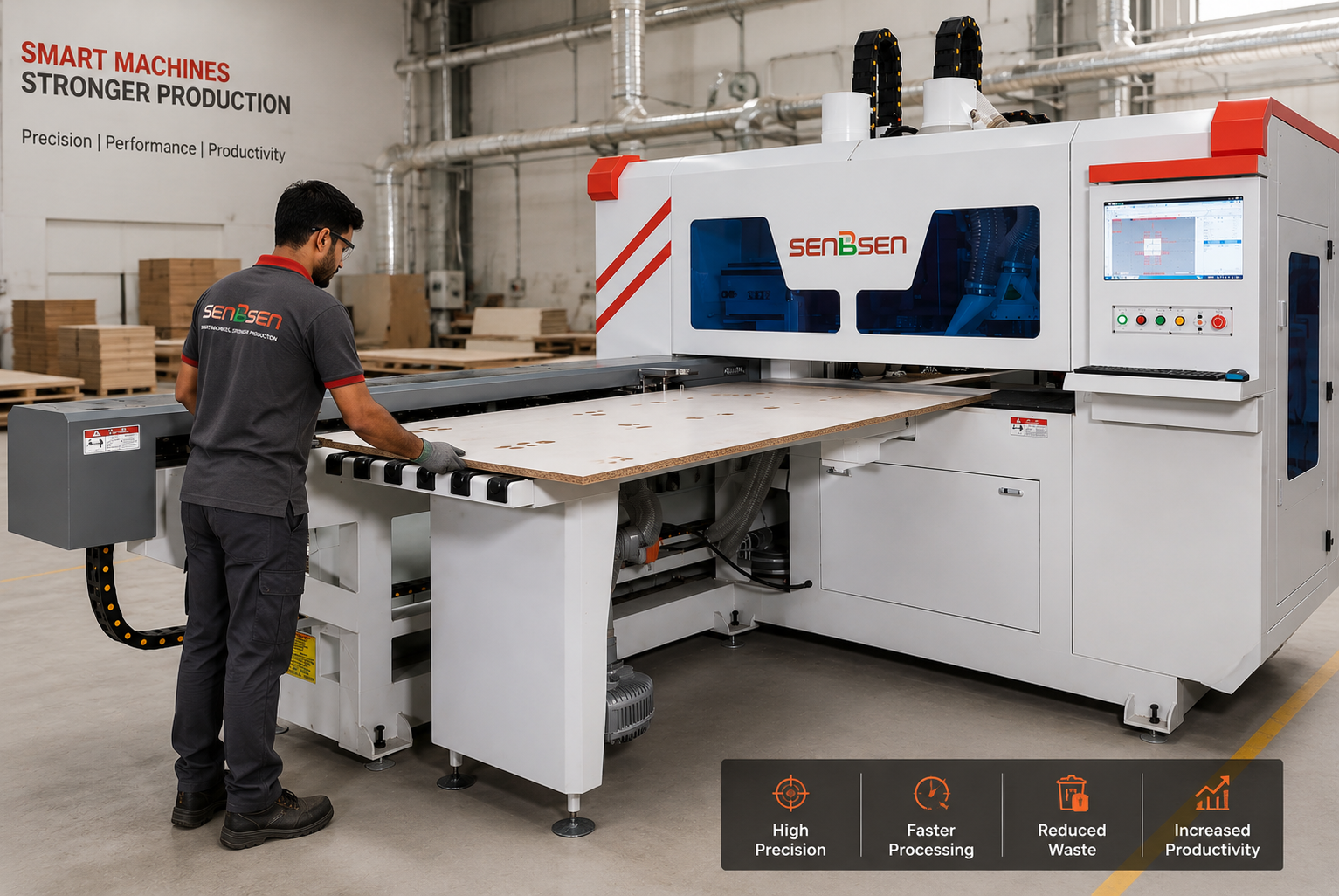
SENBSEN CNC6025 Drilling Machine
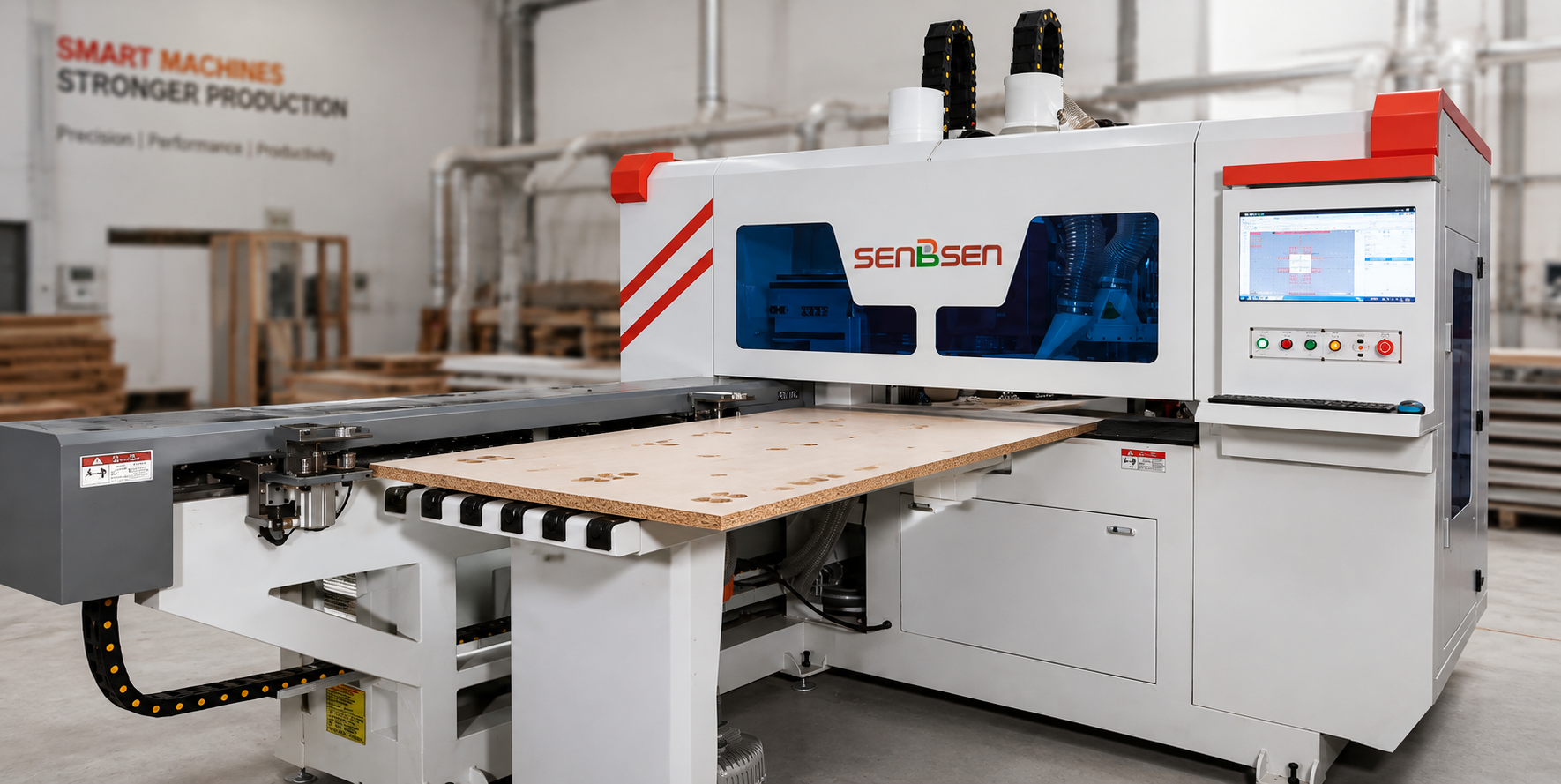
Once you know what to look for, the next step is finding a machine and a partner that can deliver it. The SENBSEN CNC6025 Drilling Machine is designed for modular furniture manufacturers who want CNC-level accuracy in their drilling process.
Machine overview
The CNC6025 is a CNC-controlled drilling machine for furniture panels. Hole positions and sequences come from a program, so operators load a job, set the panel and let the machine do the precise work.
Main applications
It is built for the drilling work modular kitchens depend on: connector and dowel holes, shelf-support rows, hardware holes and other panel drilling for cabinets and carcasses.
Accuracy and productivity benefits
CNC control removes manual marking and measuring. That means repeatable hole positions across every panel, fewer rejected boards and faster turnaround from cutting to assembly.
Modular furniture applications
Beyond kitchens, the CNC6025 suits wardrobes, storage units, office furniture and other panel-based furniture where hole patterns change from order to order.
Why it suits professional woodworking production
For factories moving from manual or semi-automatic drilling, a CNC drilling machine is the step that brings consistency at volume. It also fits naturally into a complete SENBSEN production line.
Installation, training and after-sales support
SENBSEN supports customers across India with machine installation, operator training and after-sales service from its technical team, so your machine is productive from day one.
Key specifications
Working panel size: 70–2800 × 30–1200 × 9–60 mm
Drilling spindles: 12 + 8 + 9
Positioning accuracy: High Precision
Control system: CNC Control System
Total power: 24 kW
Drilling Machine Applications in Modular Furniture
The same drilling machine that makes your kitchens can serve your entire modular furniture range.
Kitchen cabinets: base units, wall units, tall units and corner cabinets.
Wardrobes: side panels, shelves, hanging-rod fittings and shutter hinges.
Storage units: bookshelves, TV units, shoe racks and utility storage.
Office furniture: workstations, pedestals, filing cabinets and storage cupboards.
Modular furniture: flat-pack and ready-to-assemble products that depend on precise connector holes.
Shelving systems: adjustable shelving with evenly spaced shelf-support holes.
Cabinet doors and panels: hinge cups, handle holes and hardware fittings on shutters and drawer fronts.
Drilling Machine + Other Woodworking Machines
A drilling machine performs best as part of a complete production workflow. In a typical modular furniture factory, panels move through these stages:
Panel Saw Machine: cuts large boards into accurately sized panels.
CNC Woodworking Machine: handles routing, nesting, grooving and shaped cuts.
Drilling Machine: drills hardware, connector and shelf holes with CNC precision.
Edge Banding Machine: seals and finishes panel edges for durability and a clean look.
Assembly: panels and hardware come together into finished cabinets.
SENBSEN supplies machines across this workflow, including panel saw machines, CNC woodworking machines and edge banding machines, as well as intelligent production lines for industrial woodworking. Matching machines from one supplier makes it easier to balance capacity between stages and to get support from a single service team.
The exact order of drilling and edge banding can vary by factory. Many manufacturers band edges before drilling so edge holes are drilled through the finished edge; your SENBSEN team can recommend the right sequence for your layout.
Frequently Asked Questions
Which drilling machine is best for modular kitchens?
For most modular kitchen manufacturers, a CNC drilling machine with multiple spindles is the best choice. It gives accurate, repeatable hole positions and handles changing cabinet sizes without manual re-setup.
What type of drilling machine is used for kitchen cabinets?
Kitchen cabinets are drilled with multi-spindle drilling machines, ranging from semi-automatic boring machines to fully CNC drilling machines. Production factories generally prefer CNC for its accuracy and speed.
Is a CNC drilling machine suitable for modular furniture?
Yes. CNC drilling is ideal for modular furniture because hole patterns are programmed, so wardrobes, kitchens, office units and storage furniture can all be drilled on the same machine.
What is the difference between manual and automatic drilling machines?
Manual drilling depends on the operator to mark and position every hole, so it is slower and less consistent. Automatic and CNC machines position and drill holes by themselves, giving higher speed and repeatability with less labour.
How accurate should a modular kitchen drilling machine be?
It should be accurate enough that hinges, connectors and shelf supports fit without adjustment on site. Ask suppliers for the machine's positioning accuracy and repeatability, and check them against your hardware manufacturer's requirements.
Can a drilling machine drill hinge holes?
Yes, provided it has the right spindle and tooling for concealed-hinge cups. Confirm with your supplier that the machine supports the hinge-cup diameter and depth your hardware needs.
How does CNC drilling improve modular furniture production?
CNC drilling removes manual marking, cuts cycle time per panel, reduces rejected boards and makes every panel identical. The result is faster production and cabinets that assemble cleanly at the customer's site.
How do I choose the right drilling machine for my furniture factory?
Start with your daily volume, panel sizes, hole patterns, space, operator skill and budget. Then choose a supplier that provides installation, training and reliable after-sales service in your region.
Conclusion
For modular kitchen manufacturing, the best drilling machine is one that provides accurate hole positioning, repeatable drilling, efficient production and easy operation. For professional and high-volume manufacturing, an automatic or CNC-based drilling solution is generally more suitable than manual drilling.
Start by understanding your production volume, panel sizes and hole patterns. Then compare machines on accuracy, spindle configuration, software and after-sales support, not just price.
If you are planning to upgrade your drilling process, the SENBSEN team can help you evaluate your production needs and recommend the right machine, from the CNC6025 Drilling Machine to a complete line with panel saws, CNC woodworking machines and edge banders.
Talk to SENBSEN: call +91 87080 56233, email info@senbsen.in, or visit senbsen.in. Follow us on Instagram at @senbsenindia.