Indian furniture manufacturers today face a common challenge. Customers want customised modular kitchens and wardrobes, delivered faster, with a perfect fit at site. Manual cutting and drilling struggle to keep up. This is where a CNC woodworking machine makes a real difference.
But there is no single "best" CNC machine. The right choice depends on what you make, the panels you process, your production volume, and how your factory workflow is set up. This guide will help you make that decision.
What Is a CNC Woodworking Machine?
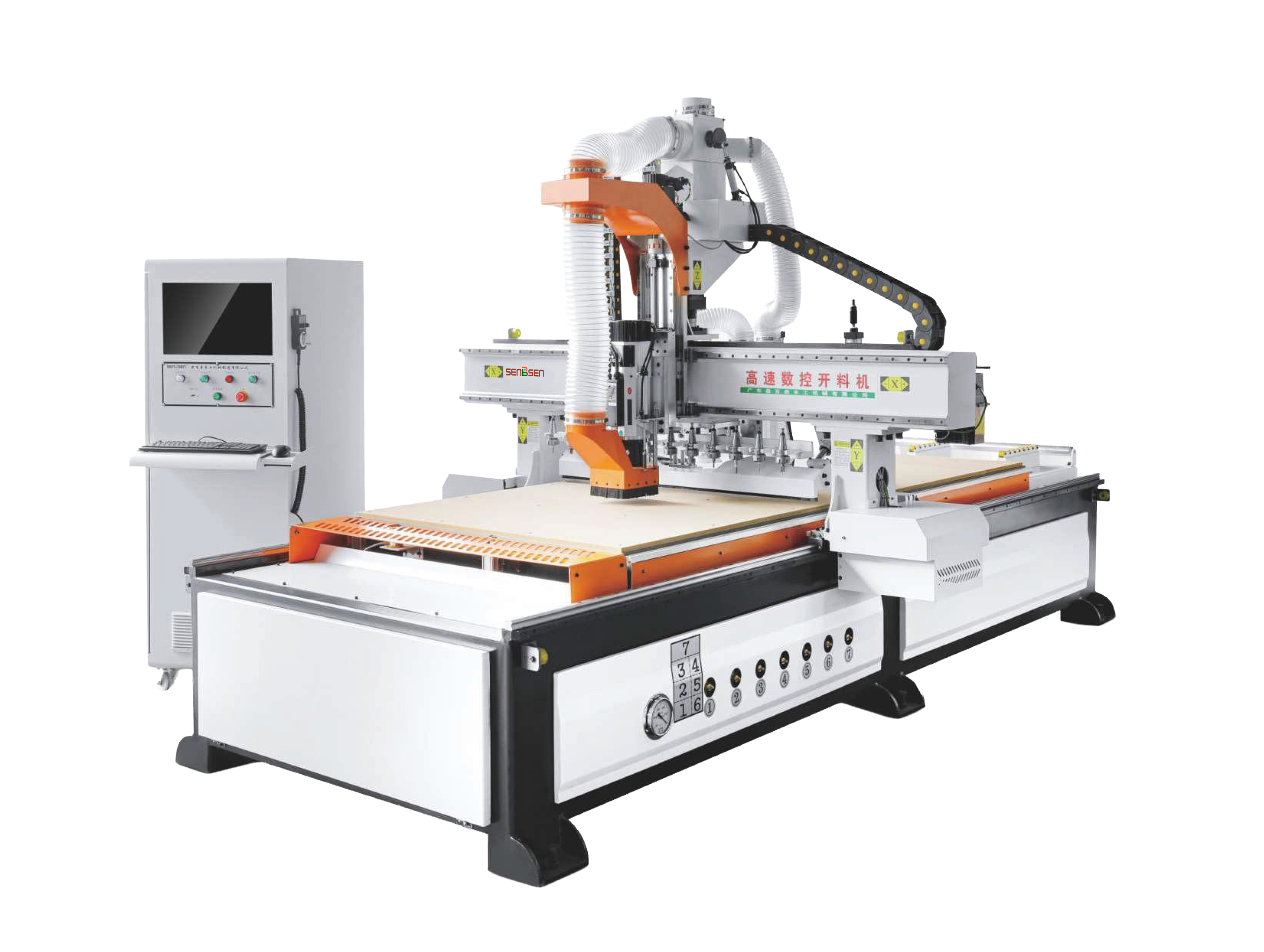
A CNC (Computer Numerical Control) woodworking machine processes wood and wood-based panels according to programmed instructions, instead of relying on manual control. Once a design is converted into a machine program, the machine can cut, route, groove, drill and shape components with the same accuracy every time.
For furniture manufacturers, this means repeatable parts, fewer fitting problems during assembly, and less dependence on individual operator skill.
Types of CNC Machines Used in Furniture Manufacturing
Before comparing brands or prices, first understand which type of CNC suits your work.
1. Nesting CNC Router
A nesting CNC processes a full panel sheet in one setup. It arranges parts efficiently on the sheet to reduce waste, then cuts, grooves and drills them. It works well for modular kitchens, wardrobes and cabinet carcasses where many different parts come from standard sheets.
2. ATC (Automatic Tool Changer) CNC Router
An ATC machine changes cutting tools automatically during a job. This saves the time an operator would otherwise spend changing tools manually, which is especially useful when one job needs several operations.
3. CNC Boring / Drilling Machine
These machines are dedicated to accurate hole drilling for hinges, shelf pins, dowels and connectors. Many high-volume panel furniture factories use them alongside a nesting CNC or panel saw.
4. Multi-Head or 4-Axis CNC Router
Manufacturers of doors, carved panels, solid wood furniture or curved components may need multiple spindles or an extra axis for more complex shapes.
Quick Guide: Which CNC Fits Your Business?
If your main products are modular kitchens, wardrobes and cabinets, a nesting CNC with drilling capability is usually the right choice, because it processes complete sheets with minimal waste. If your jobs are varied and need frequent tool changes, an ATC CNC router will save a lot of time by switching tools automatically. For high-volume panel furniture production, many factories pair a dedicated CNC boring machine with a nesting CNC or panel saw to keep drilling and cutting running side by side. And if you manufacture doors, carved panels or solid wood designs, a multi-head or 4-axis CNC router gives you the flexibility to handle more complex shapes.
Key Features to Check Before Buying
Machine structure: A heavy, rigid frame reduces vibration, which directly affects cutting accuracy and edge finish during long production hours.
Working area: Match the bed size to the panel sizes you use. In India, 8 × 4 ft sheets are standard, but confirm your actual requirement.
Spindle power and type: The spindle does the cutting, routing and grooving. Its power should suit your materials, whether MDF, plywood, particle board or pre-laminated boards.
Drilling unit: For cabinet and modular work, an integrated drilling unit saves a separate operation and improves hole accuracy for hardware fitting.
Control system and software: Check how easily your team can learn the controller, and whether it works with your design software and file formats.
Vacuum hold-down: A strong vacuum table keeps panels firmly in place, which is especially important for small parts and nested jobs.
After-sales support: Installation, operator training, spare parts availability and quick service response matter as much as the machine itself. A machine that stays idle for a week waiting for a technician costs far more than any upfront saving.
Benefits of CNC for Furniture Manufacturers
Accuracy and consistency: Every component matches the programmed dimensions, so modules fit correctly at site.
Faster production: Automated cutting, routing and drilling cut down manual processing time.
Less material waste: Nesting software makes better use of each sheet.
Easy customisation: Changing a design only means changing the program, not retraining the team.
Less dependence on skilled labour: Once programmed, the machine delivers the same result regardless of the operator.
How a CNC Fits Into Your Production Line
A typical CNC workflow looks like this:
Design → CNC Programming → Panel Loading → Machining → Inspection → Edge Banding → Assembly
A CNC works best as part of a complete line, not as a standalone machine. A panel saw handles straight sizing, an edge banding machine finishes panel edges, and a CNC handles the programmed cutting, grooving and drilling. When selecting a CNC, look at how it will connect with the machines you already have or plan to buy.
Questions to Ask Before You Buy
What furniture do we make, and what will we make in the next 3 years?
Which materials and sheet sizes do we process most?
How many sheets do we process per day, and what is our target?
Do we need drilling on the same machine, or a separate boring machine?
Who will run the machine, and how much training will they need?
How quickly can the supplier provide service and spare parts in our city?
SENBSEN CNC Woodworking Machines
SENBSEN supplies industrial woodworking machinery to furniture manufacturers across India, with presence in Karnataka, Kerala, Delhi and Gujarat. The range includes CNC routers, edge banding machines, panel saws, cold presses and complete production lines, so manufacturers can plan their entire workflow with one partner.
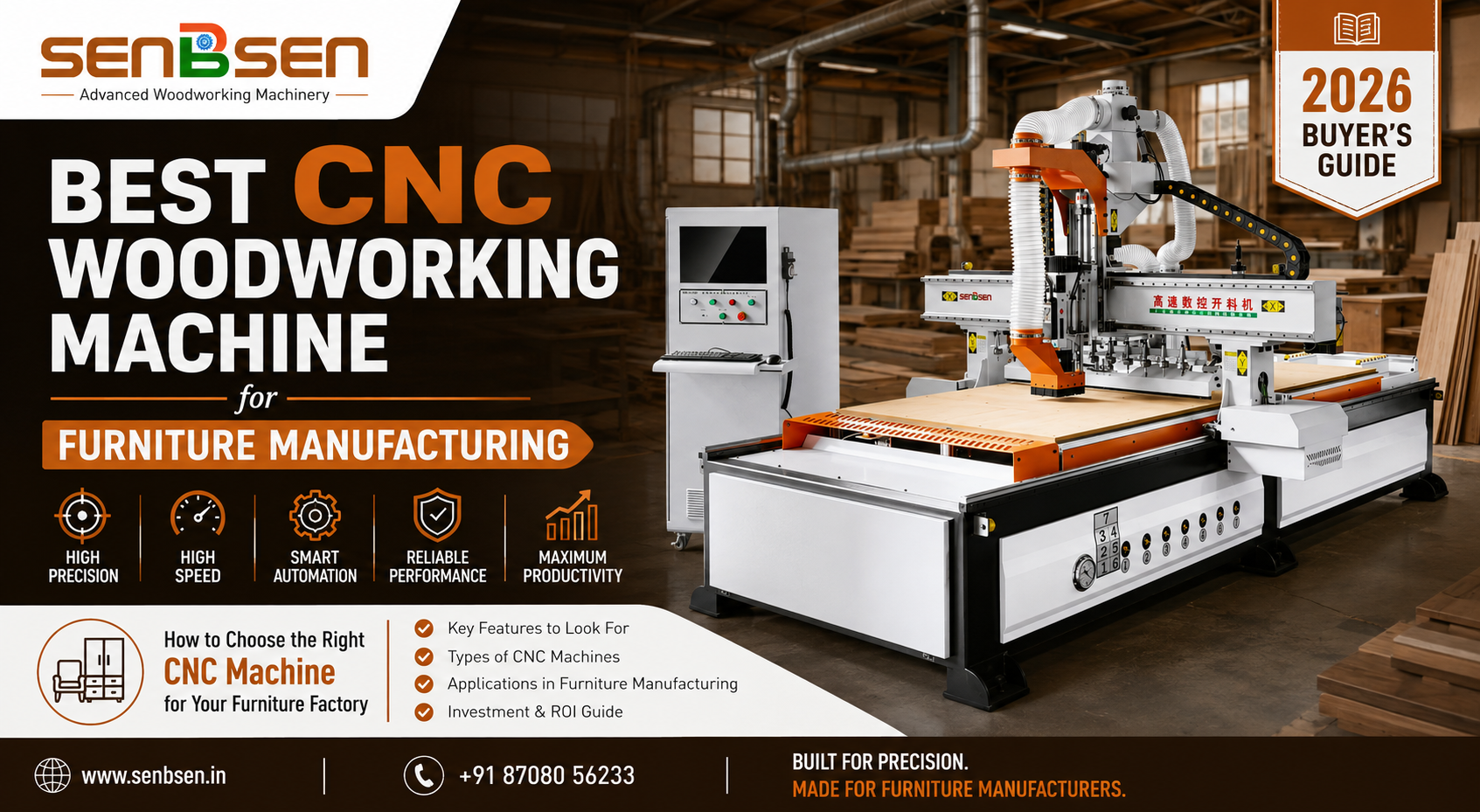
SENBSEN H9-12 CNC Woodworking Machine
The H9-12 is built for panel furniture production, supporting cutting, routing and drilling in a single workflow. Its 2750 × 1250 mm working area comfortably handles standard 8 × 4 ft sheets. A powerful 9.0 kW spindle takes care of cutting, routing and grooving, while the integrated 9-drill vertical drilling unit handles hardware holes in the same setup, with no separate drilling operation needed. The rigid machine structure supports accurate processing during continuous production, and the LNC-Baoyuan control system makes operation straightforward for your team.
Working area: 2750 × 1250 mm
Spindle: 9.0 kW
Drilling unit: 9 vertical drills
Control system: LNC-Baoyuan
Best suited for: Modular kitchens, wardrobes, cabinets, office furniture
Every SENBSEN machine comes with installation, operator training and technical support from our in-house service team.
Frequently Asked Questions
1. Which CNC machine is best for modular furniture?
For modular kitchens, wardrobes and cabinets, a nesting CNC with drilling capability is usually the most practical choice because it processes complete sheets with minimal waste.
2. Can a CNC machine process MDF and plywood?
Yes. Most CNC woodworking machines process MDF, plywood, particle board and pre-laminated boards. Always confirm the recommended materials and spindle specifications for the specific machine.
3. What is the difference between a nesting CNC and an ATC CNC?
A nesting CNC is optimised for cutting many parts from full sheets. An ATC CNC automatically changes tools during a job. Many modern nesting machines also include an ATC.
4. Is a CNC machine worth it for a small furniture workshop?
It can be, if you regularly produce repeat or customised panel components. Choose a machine size and configuration that matches your current volume, with room to grow.
5. Do I still need a panel saw if I buy a CNC?
Many factories use both. The panel saw handles fast straight cutting, while the CNC handles grooving, drilling and shaped parts. The right mix depends on your volume and product range.
6. What should I check before buying a CNC woodworking machine?
Check the working area, spindle power, machine structure, drilling capability, control system, software compatibility, and the supplier's installation, training and service support.
Conclusion
The best CNC woodworking machine is the one that fits your products, materials, volume and production line, not simply the most expensive or the most popular one. Start by identifying what you make and where your current bottlenecks are, then choose the machine type and configuration that solves them.
Need help choosing the right CNC for your factory? Talk to the SENBSEN team for a free consultation.
SENBSEN India
Site No. 51, New Katha No. 89, Vaddarahalli Village, Bengaluru, Karnataka – 562130
📞 +91 87080 56233 | ✉️ info@senbsen.in
📸 Instagram: @senbsenindia | 🌐 senbsen.in